How to Write an RFQ for Outdoor Equipment

A request for quotation (RFQ) is a written list of what you want to buy and how you want suppliers to answer. When it is vague, you receive quotes for different products, in different formats, with different assumptions, and the cheapest one may simply be the one that left things out. When it is specific, the comparison mostly does itself.
This guide covers the structure of an RFQ for outdoor equipment, how to turn adjectives into measurable requirements, and a worked example. It belongs to the Buying & Maintenance hub. It does not give legal advice; have contract terms reviewed by someone qualified, and check any rules that apply to your purchase.
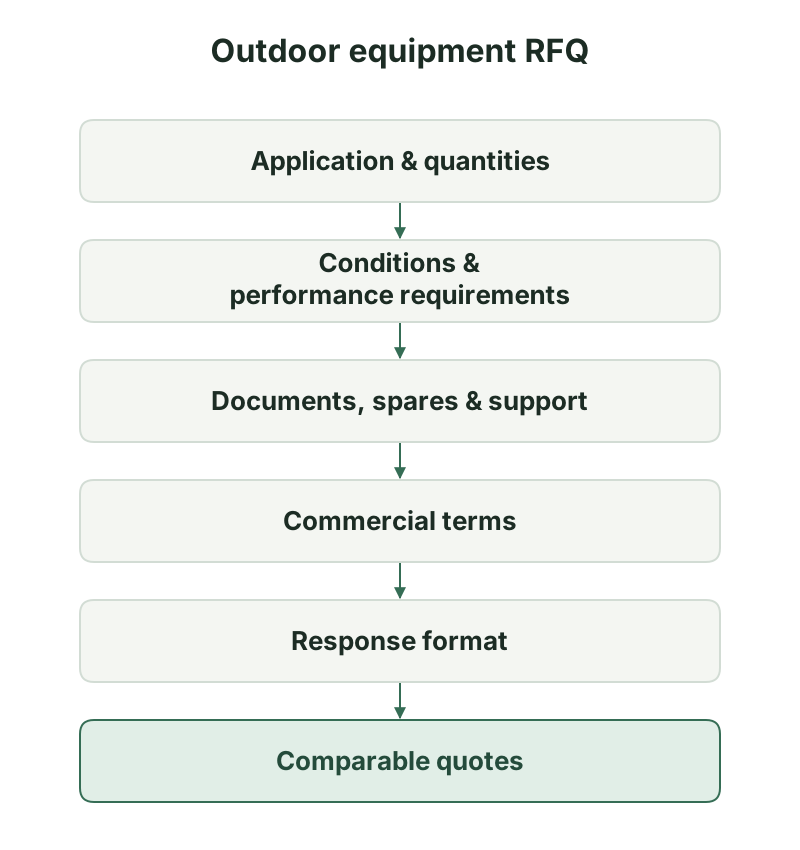
Describe the application and quantities
Say what the equipment is for before saying what it is. Suppliers can only propose a suitable product if they know the job.
- Application: the task, the location type and how long equipment stays deployed. “Lighting a gravel work yard for evening shifts” is more useful than “work lights”.
- Quantities: how many units, split by location or phase if relevant, and whether options or later add-ons might follow. State the basis for each quantity so the supplier can challenge it if it looks wrong.
- Requirement inputs: if you have already done upstream work, attach the results. A load estimate from the power station sizing guide, a case dimension list from the waterproof case checklist, or an inventory from the campground equipment checklist all give suppliers firm numbers instead of descriptions.
Operating conditions
Conditions are where outdoor equipment differs from office equipment, and where omissions cause the most disputes. Describe the environment the equipment will actually meet:
- Temperature range in use and in storage
- Exposure to rain, spray, dust, sand, salt air or washdown
- Sun exposure, wind and ground conditions where relevant
- Handling: how often it is moved, loaded onto vehicles or carried
- Power available on site, and charging opportunities
- Who operates it and what training they have
Write conditions as ranges or described situations, not as a wish. If you are unsure of a value, say “to be confirmed” and ask the supplier to state the limits of their product so you can compare them with your conditions later.
Measurable performance requirements
An adjective cannot be checked. A measurable requirement names a quantity, a value, a unit, and the condition or method under which it must be met. The method matters because two suppliers can report different numbers for the same product depending on how they measured.
| Instead of | Write |
|---|---|
| “Bright work light” | Minimum light output in lumens, stated by the supplier with the measurement method, plus the required lit area and mounting height |
| “Long runtime” | Required hours of operation at a stated load or setting, and the battery condition the figure applies to |
| “Waterproof” | Required IP code, the edition of the standard, and a request for the test report covering the offered model and configuration |
| “Rugged” | Drop height, load or vibration condition and the standard or method you expect, or a statement of what the supplier tested |
| “Fast delivery” | Delivery within a stated number of days from order, to a named address |
Two habits help:
- Separate must-have from nice-to-have. Mark each requirement Mandatory or Preferred so a supplier knows which gaps disqualify a quote.
- Ask for the basis. For every figure the supplier gives, ask whether it is a published specification, a laboratory result or an estimate, and where it comes from.
For ingress protection claims specifically, the IP ratings guide explains what a rating does and does not cover.
Documents, spares, warranty and support
Decide up front what evidence you need, and ask for it in the RFQ rather than after you have chosen a supplier.
- Manuals: user and maintenance manuals for the offered model, in a language your team reads.
- Test reports: reports that cover the offered model, with a stated scope, date and issuing body. When they arrive, use how to check an equipment supplier’s test report to match the model, read the scope and note any limits.
- Certificates: only those relevant to your jurisdiction and application. Ask the supplier what each certificate covers.
- Safety data: safety data documents where the equipment contains chemicals or batteries that require them. Transport rules for batteries differ by mode and region, so ask the supplier how they ship and check the applicable rules.
- Spares and consumables: a list of parts you are likely to need, with availability and lead time.
- Warranty: length, what it covers, what voids it, and who handles claims.
- Support: how to reach support, response expectations, and whether repairs happen locally or via return shipment.
Servicing starts with the manual. Asking for it now lets you build a schedule later with the maintenance planning guide without guessing at intervals.
Delivery, packaging and labeling
Specify where, when and how goods arrive. Ask for the delivery address, the required delivery window, packaging suitable for the transport route, and labels that let your team identify models and quantities without opening every box. If you need serial numbers recorded on delivery documents for your equipment register, say so. State who inspects on receipt and the time allowed to report damage.
Commercial terms
Keep commercial terms in their own section so that technical and price comparison stay separate.
- Price breakdown: unit price, quantity, extended price, and separate lines for spares, accessories, packaging, shipping, installation or training where relevant. State the currency.
- Validity: how long the quote holds.
- Delivery terms: many international quotes use Incoterms® rules to say who arranges transport and who bears risk at each stage. Name the rule you want quoted and confirm what it means with your forwarder or adviser.
- Payment terms: what you propose, and room for the supplier to state theirs.
- Taxes and duties: whether prices should include them or show them separately.
- Exceptions: ask suppliers to list any requirement they cannot meet, rather than leaving it unstated.
Define the quotation response format
This section decides whether you can compare quotes. Give every supplier the same table and ask them to fill it in without changing the structure. Include one row per requirement, with columns for the supplier’s response, unit, the evidence attached and notes. Each supplier then answers “what is the measured value” and “where is the proof” in the same place.
| Requirement | Mandatory / Preferred | Supplier response | Unit | Evidence attached (Y/N + reference) | Notes |
|---|---|---|---|---|---|
| (from your requirement list) | Mandatory |
Ask that the supplier does not substitute marketing text for answers. If a field does not apply, they write “not applicable” and a reason. If they cannot meet it, they write “does not meet”. A blank cell is treated as unanswered.
Evaluation criteria and deadlines
Tell suppliers how you will judge quotes. List the criteria in the RFQ, for example:
- Meets all mandatory requirements (pass or fail)
- Evidence supplied and verifiable
- Total cost, including spares, delivery and support
- Delivery time
- Warranty and support terms
You may weight them, but decide the weights before you open any quote. If a supplier fails a mandatory requirement, record that and do not renegotiate by quietly lowering the requirement. Then set the dates: when questions close, when quotes are due, when you expect to decide, and the delivery date you need. Name one contact person for questions and share answers with all bidders, so no one has an advantage.
Worked example: a hypothetical project
The following is a hypothetical project written to show the structure. It names no customer and states no price. The assumptions are invented for illustration and should not be read as a recommendation for any real site.
Assumptions. A seasonal outdoor site operates evenings for several weeks a year, without permanent buildings. The site team needs portable work lights for shared areas and portable power stations to run them. Nobody has chosen a supplier or product.
| Section | Illustrative entry |
|---|---|
| Application | Portable lighting for evening setup and tear-down on a gravel site, supplied by portable power stations. |
| Quantities | Quantities of lights and power stations, with the basis (areas to light, hours per night, load calculation attached). |
| Conditions | Temperature range, rain exposure, dust, vehicle transport; no mains power at the lighting points. |
| Performance | Light output with measurement method and required coverage; power station output and stored energy figures with the load each must support; runtime at the stated load, labeled as measured or estimated. |
| Documents | Manuals, test reports with scope, applicable certificates, battery transport information. |
| Spares and support | Spare lenses, cables, chargers; warranty terms; support contact. |
| Delivery | Single delivery to one address by a stated date, labeled cartons. |
| Commercial | Price breakdown by line, quote validity, named delivery term. |
| Response | Each supplier completes the response table. |
| Evaluation | Mandatory pass or fail, then evidence, total cost, delivery, support. |
RFQ template fields
Use these fields as a checklist, or download the CSV template. The CSV adds supplier response, unit and evidence columns so each supplier fills in the same sheet. The Checklists & Templates page lists this and other templates.
| Section | Field | What to write | Example (hypothetical) |
|---|---|---|---|
| Application | Intended use | The task and place of use | Evening lighting of a gravel work area |
| Application | Deployment period | How long the equipment stays in use | Several weeks per season |
| Application | Quantity and basis | Number of units and why | Per site plan; calculation attached |
| Conditions | Temperature range | Use and storage limits | Range to be stated by buyer |
| Conditions | Exposure | Rain, dust, salt, washdown | Rain and dust; no washdown |
| Conditions | Power available | What exists on site | No mains at lighting points |
| Performance | Requirement 1 | Quantity, value, unit, method | Light output in lumens with method stated |
| Performance | Mandatory or preferred | Whether failing disqualifies | Mandatory |
| Documents | Manuals | Models and languages | Model manual in English |
| Documents | Test reports | Report for the offered model, with scope | Report covering stated configuration |
| Documents | Certificates | Those relevant to your jurisdiction | As applicable; scope stated |
| Support | Spares and consumables | Parts list with lead time | Spare cables and chargers |
| Support | Warranty and support | Length, coverage, contact | Terms in writing |
| Delivery | Address and window | Where and when | One address; date to be stated |
| Delivery | Packaging and labeling | Condition and identification | Labeled cartons |
| Commercial | Price breakdown | Unit and line prices, currency | Supplier to complete |
| Commercial | Validity and delivery terms | Quote validity; named Incoterms® rule | Validity period; rule to be named |
| Response | Response format | Same table, no changes | Table attached |
| Evaluation | Criteria and deadlines | Order of evaluation and dates | Pass or fail, then evidence, cost |
Template version 1.0, savvyskull.com. Have contract terms and import rules checked by a qualified adviser before issuing an RFQ.
Downloads
Next steps

How to Check an Equipment Supplier’s Test Report
How to check a supplier's equipment test report: document type, issuer, model and sample match, scope, conclusions, accreditation, plus a downloadable record.
Outdoor Equipment Maintenance: Building a Practical Schedule
Build an outdoor equipment maintenance schedule from model manuals: equipment register, trigger types, task types, roles, records, and a downloadable template.