How to Size a Portable Power Station for Outdoor Work
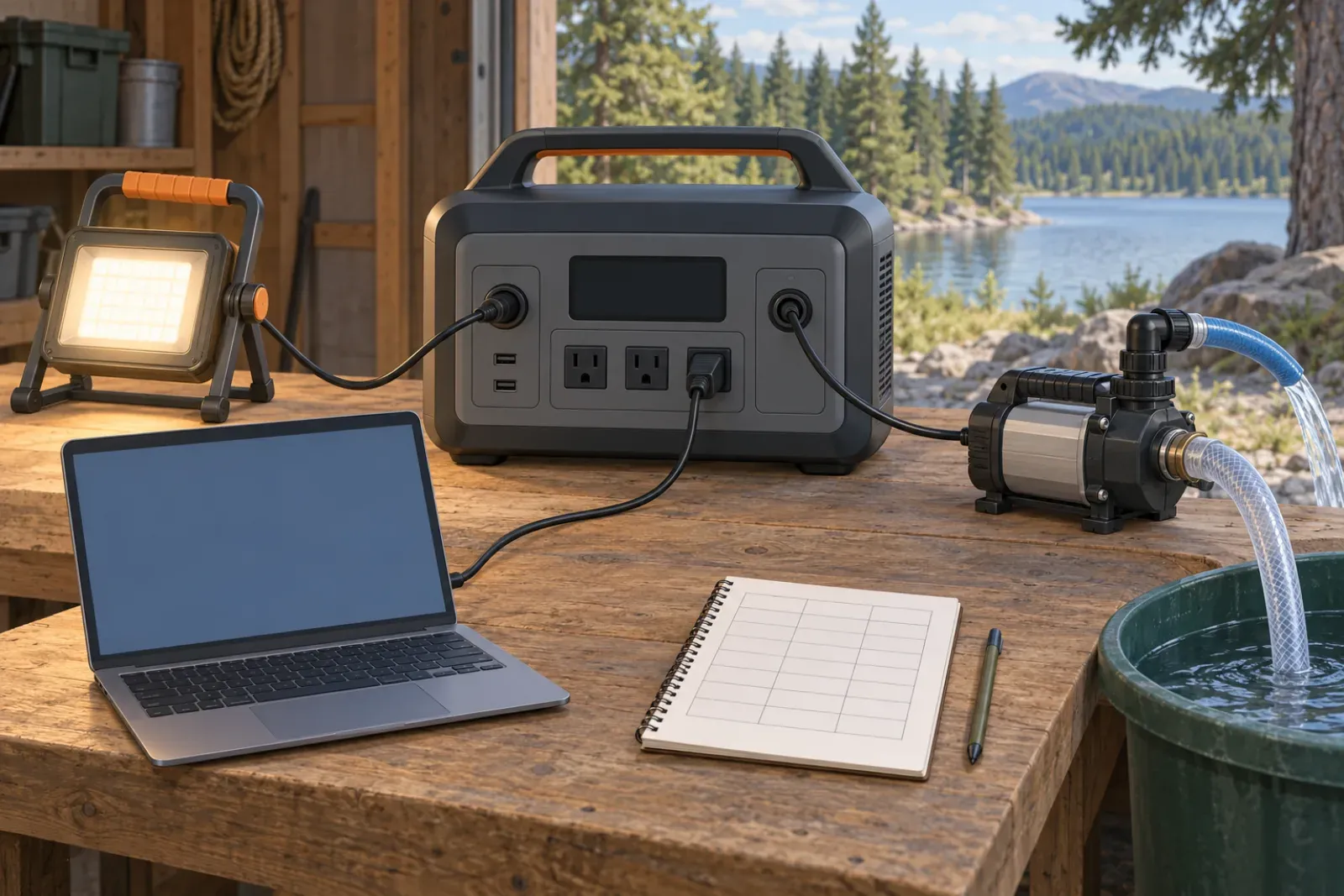
Sizing starts with a short table, not a product list. Each load gets a power figure, a run time, and a place where you found the number. The table below is the one the rest of this guide builds on.
| Step | What you record | Where the number comes from |
|---|---|---|
| Rated power (W) | What each device draws while running | Nameplate or manual |
| Startup power (W) | Short peak when a motor or compressor starts | Manual, or ask the manufacturer |
| Hours per day (h) | How long the device actually runs | Your work plan |
| Energy (Wh) | Watts multiplied by hours | Calculation |
| Station capacity (Wh) | Energy the station stores | Station manual, with usable capacity if published |
List the equipment and operating hours
Start with the work, not the station. Write down every device that must run from stored power: lights, chargers, communication gear, small pumps or fans, test instruments. For a lighting plan, the portable work light buying guide covers how to define the task and the area so you know how many lights you need.
For each device, record two things from its nameplate or manual: rated watts while running, and, where it has a motor or compressor, the startup (surge) watts. Then record how many hours per day it runs. Be honest about duty cycles. A light on all evening runs for hours; a pump that fills a tank for ten minutes does not.
According to the U.S. Energy Information Administration, watts measure power at a specific moment, while watthours measure electricity used over time. One watthour is the energy of one watt used for one hour. That gives the core formula:
Watt-hours (Wh) = rated watts (W) × hours of use (h)
Use the manufacturer’s published figure when one exists, such as a consumption value in the manual. A label that says “up to” a power level describes a maximum, not an average, so note that in the Source column. If the only figure you have is a rounded estimate, say so in the Notes.
Power station sizing worksheet
Copy this table, or download the CSV worksheet and its full template from the Resources page.
| Device | Rated watts (nameplate) | Startup/surge watts (manual) | Hours per day | Watt-hours per day | Source |
|---|---|---|---|---|---|
| (device 1) | |||||
| (device 2) | |||||
| (device 3) | |||||
| Total Wh per day |
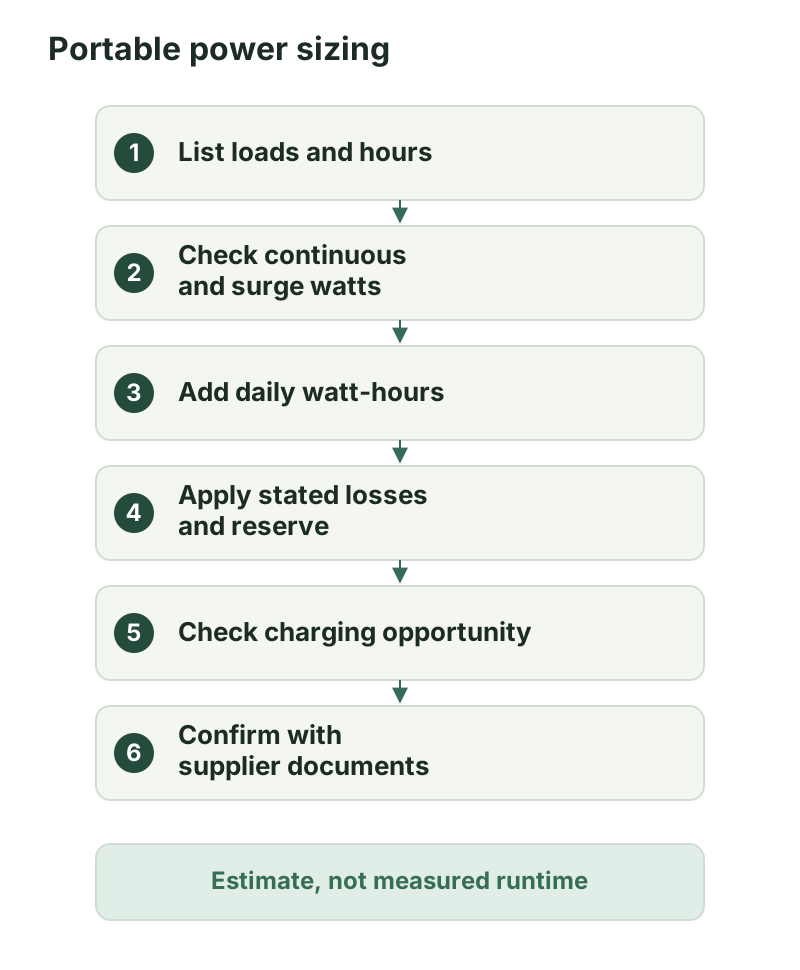
Illustrative example
The numbers below are made up to show the arithmetic. They are not specifications of any real device and are not measured results. The assumptions are:
- An LED work light with a 20 W nameplate rating, used 6 hours a day.
- A laptop charger rated 65 W, assumed to draw its full rating for 4 hours a day (a conservative simplification; real draw varies).
- A small pump rated 250 W while running, used 0.5 hours a day. Its startup figure must come from the pump’s own manual. For this example we assume the manual lists 750 W.
- All three run from the station’s AC outlets.
| Device | Rated watts | Startup/surge watts | Hours per day | Watt-hours per day | Source |
|---|---|---|---|---|---|
| LED work light (example) | 20 | none listed | 6 | 120 | Assumed nameplate |
| Laptop charger (example) | 65 | none listed | 4 | 260 | Assumed nameplate |
| Small pump (example) | 250 | 750 | 0.5 | 125 | Assumed manual |
| Total Wh per day | 505 | Sum of rows |
The arithmetic is 20 × 6 = 120 Wh, 65 × 4 = 260 Wh, and 250 × 0.5 = 125 Wh. The daily total is 120 + 260 + 125 = 505 Wh.
Check continuous output and startup requirements
Capacity in Wh says how long the station can supply energy. Output in W says how much it can supply at once. Both must work.
Continuous output is the power the station says it can deliver without stopping. Add up the rated watts of everything that will run at the same time. In the example, if the light, charger and pump all run together, the running load is 20 + 65 + 250 = 335 W. The station’s continuous AC rating, from its manual, must be higher than that.
Surge output is a short peak the station can supply. Some loads draw much more at startup than while running: motors, compressors, some power tools and some pumps. Check the load’s manual or nameplate for a startup or locked-rotor figure. If neither exists, ask the manufacturer rather than guessing. Resistive and electronic loads such as many LED lights and chargers usually do not have a large startup surge, but confirm in the manual. For the example pump, the 750 W figure assumed above has to fit inside the station’s published surge rating, and the other loads running at that moment add to it.
A station can have plenty of watt-hours and still shut down at startup if its surge rating is too low. A station with high output and small capacity will run a heavy load but only briefly.
AC and DC outputs
Most stations offer AC outlets, USB ports and one or more DC outputs. AC output goes through an inverter, which converts stored DC energy to AC and loses some energy as heat. Where a device can run directly from a DC output, the manual may show a lower loss. Whether it does depends on the specific station and device, so check the published efficiency information, if any, instead of assuming.
Rated versus usable capacity
The capacity printed on a station is a rated figure. Some manufacturers also publish usable capacity or output efficiency, and some do not. If a manual gives a usable figure, use it and cite the page. If it does not, state your own assumption in the worksheet and label it as an assumption.
Estimate usable energy with explicit assumptions
Raw daily watt-hours understate what you need. Two adjustments are common, and you must write down both.
- Conversion loss. Energy is lost in the inverter and other circuitry. Use the manufacturer’s published efficiency if there is one. If there is none, pick a percentage, say what you chose and why, and list it as an assumption.
- Reserve margin. A buffer for unplanned work, aging, and cold conditions. State the percentage and the reason, for example “extra evening shift possible.”
Continuing the illustrative example, assume 15% conversion loss and a 20% reserve. These are example percentages, not recommendations.
- Energy after losses: 505 Wh × 1.15 = 580.75 Wh.
- With reserve: 580.75 Wh × 1.20 = 696.9 Wh, rounded to about 700 Wh.
The result is an estimate of the capacity needed under these assumptions: about 700 Wh. It is not a measured runtime of any product. If a candidate station’s manual lists usable capacity above that, it may suit the plan on paper, but only the supplier documents and your own trial can confirm real-world performance.
Change the assumptions and the answer changes. That is why the worksheet makes you write them down.
Temperature effects
Battery capacity and charging performance can change in hot or cold weather. Manuals typically give an operating temperature range for discharging and a separate range for charging. Check the manual for the charging temperature range, and plan extra reserve if the site is outside the comfortable middle of that range. Do not assume the rated capacity is available in all weather.
Review charging opportunities and operating limits
A station that cannot be recharged is a one-use tool. Check the inputs the manual lists:
- AC charging from a wall outlet, generator or site power pedestal. Note the published charging input and any time the manual gives for a full charge.
- Vehicle (DC) charging, usually through a 12 V socket. Many manuals list a lower input limit for this route than for AC.
- Solar input. The manual gives a voltage and power range the station accepts. Panels outside the range may not charge it. The U.S. Department of Energy’s solar PV design basics is a starting point for the concepts, but your panel and station documents decide compatibility.
Pass-through charging means using the station to power loads while it is itself charging. Treat it only as a question: does the manual say it is supported, and are there limits on input or output while doing so? If the manual is silent, ask the supplier.
Write the published input limit next to each charging method, and compare the daily watt-hours from your worksheet against what you can realistically put back in a day.
Shipping and transport
Transport rules for lithium batteries are written in watt-hours. As one example, the FAA states that lithium-ion batteries carried by air passengers are limited to a rating of 100 Wh per battery, with exceptions handled by airline approval. That page covers passenger carriage only. Check the rules that apply to how you will ship or carry the station, and confirm the Wh rating on its label or in its manual before you travel.
Questions to send to suppliers
Send the worksheet totals and ask for answers in writing, with the document and page where each answer appears.
- What is the rated battery capacity in Wh, and is a usable capacity or output efficiency published?
- What are the continuous AC output and the surge output, and for how long can the surge be sustained?
- Which loads in our list exceed either rating, and what does the manual say about them?
- Which AC, vehicle and solar charging inputs are supported, and what are the published input limits?
- Is operating while charging (pass-through) supported, and under what limits?
- What are the operating and charging temperature ranges?
- What are the battery’s Wh rating and transport classification, so we can check shipping rules?
- What manual-based care and storage steps apply? Our maintenance planning guide shows how to record those.
- Which documents can you send: manual, specification sheet, test reports?
Once the requirements are settled, put them in a request for quotation. The RFQ guide shows how to structure it so quotes can be compared. For the wider picture of lighting, batteries and field power, see the Power & Lighting hub.
Conditions and limits of this method
- The worksheet is only as good as the figures entered. Nameplate watts are a maximum or typical rating, not a measurement of your device.
- Real runtime depends on load profile, temperature, battery condition and the station’s own efficiency. The estimate does not predict it.
- This guide is a desk method based on published documentation. It does not rely on any hands-on testing of power stations.
- It gives no guidance on electrical installation, wiring or battery modification. Follow the manuals and applicable local rules for those.
Downloads
Sources and versions
- Measuring electricity , U.S. Energy Information Administration Supports: Watts measure power at a specific moment; watthours measure electricity used over time; one watthour is one watt used for one hour
- Lithium batteries , Federal Aviation Administration (PackSafe) Supports: Example that transport rules are written in watt-hours: lithium-ion batteries carried by air passengers are limited to a rating of 100 Wh per battery, with exceptions handled by airline approval
- Solar photovoltaic system design basics , U.S. Department of Energy Supports: Background on solar PV systems as a charging source
Next steps

How to Write an RFQ for Outdoor Equipment
How to write a request for quotation for outdoor equipment: measurable requirements, documents, commercial terms and a response table that makes quotes comparable.
Outdoor Equipment Maintenance: Building a Practical Schedule
Build an outdoor equipment maintenance schedule from model manuals: equipment register, trigger types, task types, roles, records, and a downloadable template.