SavvySkull Historical Blog Reference
Historical context and source references for the former SavvySkull blog, with a verified 2006 background source and an honest list of what has and has not been confirmed.
This page provides historical context and source references for the former SavvySkull blog. It is maintained by DeltaSpark and does not represent the former author. Any current commentary is identified separately from historical material.
Verified historical background
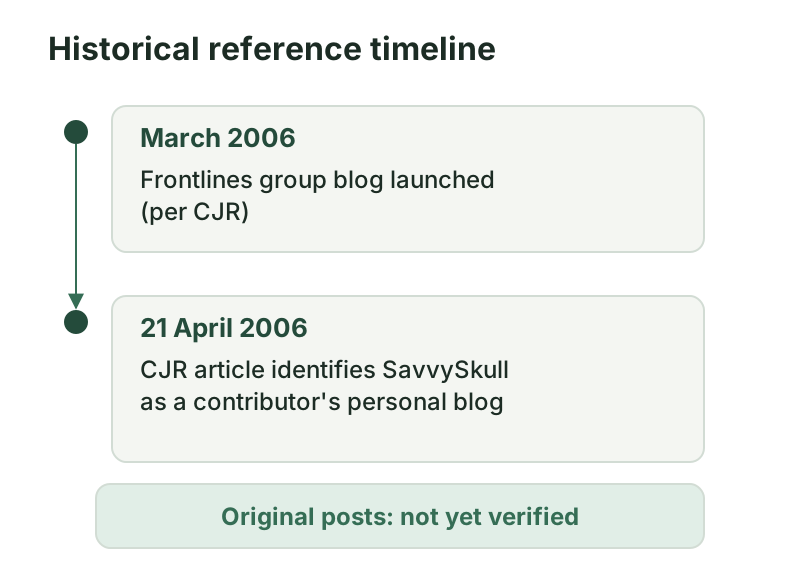
The one source confirmed for this page is a Columbia Journalism Review article by Paul McLeary, published April 21, 2006. According to that article, the New York Times launched a group blog called Frontlines in March 2006. It was written by four active-duty soldiers and Marines deployed in Iraq, and it was placed behind the TimesSelect pay wall.
The article names Army Captain Will Smith, then 30 and serving in Tikrit, as one of the contributors, and identifies SavvySkull as that contributor’s personal blog. That is the extent of what the source says about the blog. The other Frontlines writers are not SavvySkull authors, and titles of pages on the Times site are not titles of posts on the former blog.
What the 2006 coverage describes
The CJR piece is a report on how a newspaper chose to publish writing from people serving in a war zone. Read closely, it supports the following points and no others.
- The New York Times started the Frontlines group blog in March 2006.
- Four active-duty soldiers and Marines deployed in Iraq wrote it. The article describes the contributors as serving personnel writing from the field.
- The blog sat behind the TimesSelect pay wall, which meant that readers needed a paid subscription to see it.
- The article identifies SavvySkull as the personal blog of one contributor, Army Captain Will Smith, who was 30 at the time and serving in Tikrit.
- The article cites a count of at least 332 service members blogging from Iraq at the time, which places the former author among a large group of serving personnel who wrote online in that period.
- The article discusses the limits that military rules placed on such writing, and the care that contributors took not to reveal sensitive information.
The article is about the Times project and the wider practice of military blogging. It is not a review or summary of the former blog’s posts, and it does not describe what Will Smith wrote there. Nothing on this page should be read as a description of that content.
What this page does and does not establish
This page establishes that a reputable publication, in April 2006, named SavvySkull as the personal blog of a Times Frontlines contributor. It records where that statement can be read, so that anyone researching the history can check it.
It does not establish what the former blog contained, how long it ran, or when it stopped. It does not establish who owned the domain at any point between 2006 and today, and it does not establish that any particular post exists, since no post has yet been verified. It does not give the former author’s views on any subject, and it does not say anything about the other Frontlines contributors. The current SavvySkull site is not a continuation of the former blog, and a reader should not infer from this page that the two are connected in subject, authorship or editorial approach.
Original coverage and archive sources
- Columbia Journalism Review, “New York Times Goes to the Source,” April 21, 2006. Read the article.
Archived copies of the former blog have not been verified for this page. Until they are, this page does not describe the contents of the blog or quote from it.
Confirmed entries and materials
No original posts are listed yet, because none has been verified for this page. An entry will appear here only after its text, date, authorship and rights are confirmed. Where material is used with permission, it is logged with its original URL, rights holder and permitted use, as described in the editorial policy.
How entries are verified before they appear
Each candidate entry goes through the same steps, in this order.
- Original URL. We record the address at which the material was published on the former blog.
- Text source. We need the actual text, either from a reliable archive snapshot or from a copy supplied by the rights holder. A title alone, a file name or a search result is not enough.
- Date. We confirm when the material was first published, from the snapshot, the copy or other direct evidence.
- Authorship. We confirm who wrote it, and we keep the original attribution.
- Rights and permitted use. We confirm who holds the rights and what use they permit, such as displaying the full text, an excerpt or a link only.
- Review. An editor reviews the record against the evidence before anything is published.
An entry that fails any step is not listed, and we do not fill the gap with a summary or a guess.
How historical addresses are handled
Old addresses from the former blog may still be linked from other sites. We handle them with a few firm rules.
- Only a verified address returns a page. If an entry has passed the checks above, its original address can show it.
- An unknown address returns a genuine “not found” response. We do not serve a placeholder that pretends to be content.
- There are no redirects to unrelated pages. Sending a visitor from an old address to the home page or to an equipment guide would mislead them about what they will find, and search engines treat that pattern as a soft error. Google’s guidance on site moves recommends that removed content return a not-found or gone response.
- A specific old address is redirected only to a page that directly corresponds to it, meaning the same subject and the same reader need, not merely a shared broad topic.
How to share material or a correction
If you hold a copy of the former blog, can show rights in it, or have found a mistake on this page, write to [TBC: contact email]. Include the original address of the material and the evidence you have: an archive link, a copy of the text, the date, who wrote it, and what you can show about rights. The contact page explains what else helps, and how messages are handled. Corrections to this page are made when the evidence supports them, and the change is described in an update note on the page.
Editorial note
The dates on this page, all in 2006, belong to the events described and to the Columbia Journalism Review article. This note is current commentary by DeltaSpark and carries no date of its own.
The current SavvySkull website is a separate publication about outdoor equipment, operated by DeltaSpark. It does not continue the former blog, and it does not speak for the former author. For how the current site works, see the About page, and for how sources and corrections are handled, see the editorial policy.
Rights holders, and anyone who holds copies of the former blog, can write to [TBC: contact email]. Please include the original address of the material and what you can show about its date, authorship and rights.
Sources
- New York Times Goes to the Source , Columbia Journalism Review (Paul McLeary) Supports: Frontlines group blog launched by the New York Times in March 2006; one contributor's personal blog was SavvySkull