Editorial Policy & Research Methods
How SavvySkull guides are researched, sourced, illustrated and corrected, including how AI assistance is used and who is responsible for what is published.
This page describes the rules SavvySkull guides follow. DeltaSpark is responsible for what is published. The diagram shows the path every guide takes, and the sections below explain what each step means in practice.
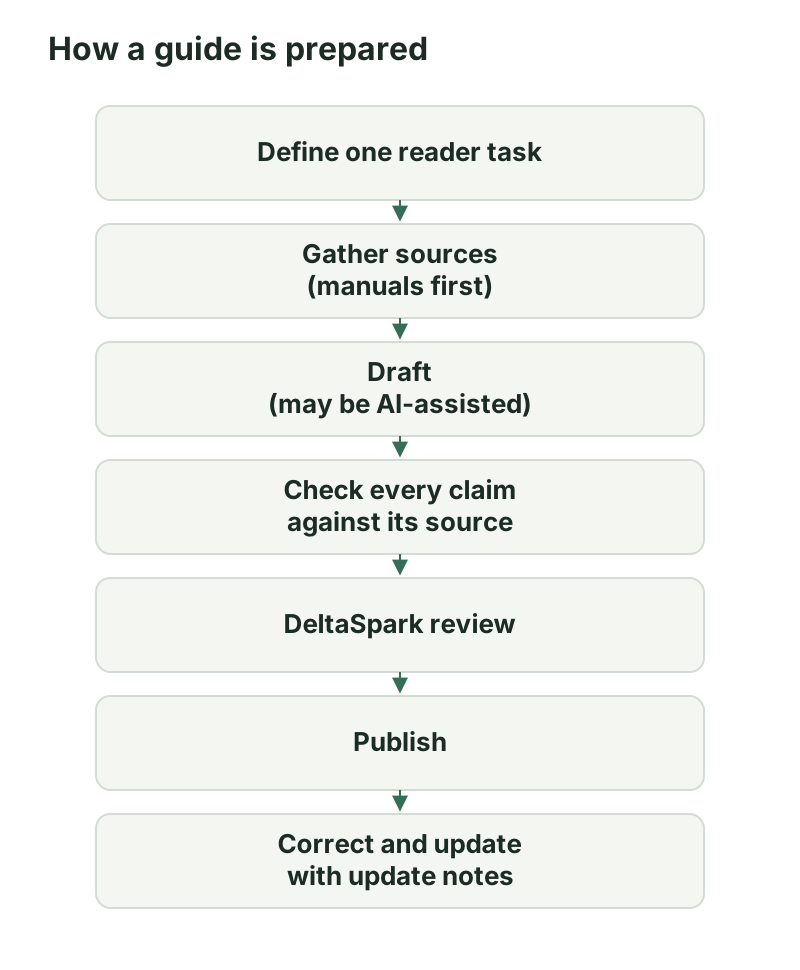
What each guide must deliver
Each guide addresses one clear task, such as sizing equipment, reading a protection claim, or writing a request for quotation. Each guide also provides at least one reusable asset: a comparison table, a checklist, or verification steps a reader can apply to their own situation. The reusable tables are collected on the checklists and templates page.
How a reader task is chosen
We start from a task that a buyer, site lead, engineer or maintenance team has to finish, not from a product category or a keyword. The test is simple: if every commercial link were removed, could the reader still complete the task with the page alone? If the answer is no, the topic is not ready. Topics are grouped into four areas, listed on the power and lighting, cases and protection, camp and site equipment and buying and maintenance hubs. We do not publish “best product” lists, because without documented testing we have no basis for ranking.
Source priority
We prefer sources in this order:
- Model manuals for the specific equipment under discussion.
- Original test documents.
- Standards publishers and accreditation bodies.
- Public technical documentation from government agencies and technical organizations.
Manufacturer statements are used where they are the only source, and they are labeled as manufacturer statements. A claim in marketing copy is not treated as a verified fact. Where we cannot verify something, the guide says so and points readers to the current edition of the standard or the model manual.
When sources conflict
Sources sometimes disagree, for example when a product page and its manual state different figures. In that case the more specific and more controlled document wins: the manual for the exact model outranks a general product page, and an original test document outranks a summary of it. If the disagreement cannot be settled, the guide does not pick a side quietly. It states that the documents differ, names them, and tells the reader to ask the supplier which one applies to the model being bought. The same approach appears in the guide to checking a supplier’s test report, where conflicting identifiers between a report and a product are treated as a reason to stop and ask.
Recording editions, models and scope
Standards are revised, and models change. When a guide cites a standard, it records the edition, and where the edition is unknown it says so and tells the reader to check the current one. When a guide discusses a figure for a product, it identifies the model and version the figure belongs to. When a claim only applies in certain conditions, such as a protection rating that covers a specific sample configuration, the guide states that scope next to the claim. How to read IP ratings shows why this matters: the same code can describe different configurations.
Units and conversions
Units are always shown. Power is given in watts and energy in watt-hours, lighting in lumens or lux, and the guide says which one it means. Where a conversion is needed, the formula and the numbers are written out so the reader can repeat it. For example, the sizing method multiplies watts by hours to get watt-hours. We do not mix units in a table without labeling them.
Phrasing we use
- “According to the manufacturer’s published specifications…” for figures that come from a manufacturer.
- “This comparison is based on published documentation…” for desk research.
- “We tested…” only for a real, documented test. A guide that uses it must state what was tested, who carried out the test, the conditions, and the limits of the result.
Research-based guides are not hands-on tests, and we do not present them as such.
Examples, estimates and assumptions
Worked examples are illustrative and are labeled as such. Each one lists its assumptions. An estimate is never presented as measured performance. The power station sizing example in the sizing guide is a good model: it uses made-up device ratings, says they are not the specifications of any real device, shows the arithmetic, and calls the result a planning estimate. If a number in a guide is not from a cited source, the guide says it is an assumption.
How test reports are read
Some guides discuss test reports that suppliers provide. We read them as documents with a specific scope, not as proof of general quality. A report supports a claim only when it covers the model and configuration in question, and the issuer can be confirmed independently. The method is described in how to check an equipment supplier’s test report. Reading a report in this way is not the same as running a test, and the guides do not describe it as testing.
Dates
SavvySkull pages do not display publication dates. When a page changes substantively, an update note on the page says what changed. Dates of historical events are stated as facts in the text of the page where they matter.
Images
Illustrations and diagrams are created to explain a point. They are labeled as illustrations or diagrams, and they are never presented as test photos, field evidence, or pictures of a real product. Some images may be produced with AI image tools. A caption always says what kind of image it is.
AI-assisted drafting
Drafts may be prepared with AI assistance. AI output is never treated as a source. Every factual statement must trace to a cited source, and the cited source is checked before publication. Tools can help with structure and wording, but they do not decide what is true, and they do not replace the source check.
Review before publication
Before a guide goes live, DeltaSpark reviews it. The review looks at whether the short answer matches the body, whether each claim has a source or is labeled as an assumption, whether examples are marked as illustrative, and whether any commercial relationship needs a label. A review by DeltaSpark is an editorial review. It is not a technical certification, and it does not turn a research-based guide into a tested one.
Bylines and reviewers
Guides carry the SavvySkull Editorial byline by default (see the byline page). A real author or a technical reviewer is named only when that person took part and their identity can be verified. The byline does not imply a team of any particular size.
Updates and corrections
When a guide changes substantively, we update it and add an update note that says what changed and why. Small fixes such as typos do not need a note. If a reader or an editor finds a factual error, we correct the page and note the correction on the page in an update note. To report a problem or suggest a better source, use the contact page.
Licensed historical material
Where historical material is republished under permission, it is logged item by item: the original URL, the rights holder, and the permitted use. Anything the permission does not cover is not reused. Historical context is kept on the historical blog reference, separate from current guides.
Commercial relationships
How ownership, sponsorship, affiliate links and supplied products are disclosed is described on the disclosures page. A disclosure does not change the source rules on this page: a claim from a sponsor is held to the same standard as any other.