How to Check an Equipment Supplier’s Test Report
Suppliers often answer “is it tested?” by attaching a PDF. The PDF may be a full laboratory report, a one-page certificate, a marketing summary or a document about a different product. This guide gives a fixed order for reading it, so you end with a short record of what the document proves and what you still need to ask. It sits in the Buying & Maintenance hub alongside the guides on procurement and upkeep.
Use it for claims you intend to rely on, for example a case rated for immersion or a handheld described as drop tested. Our guides on reading IP rating claims and choosing a waterproof equipment case explain the claims themselves. This guide covers the evidence behind them.
Identify the document and issuing organization
Different documents answer different questions. Decide which one you hold before reading further.
| Document | What it normally states | What it does not state |
|---|---|---|
| Test report | Method, sample, conditions, results, issuer | That the product line complies in general |
| Certificate or certification mark | A certification body’s decision under a named scheme | Detailed test conditions |
| Listing | That a product appears in a body’s directory | Anything beyond the listing’s scope |
| Declaration of conformity | The manufacturer’s own statement | Independent verification |
| Datasheet or brochure | The manufacturer’s claims | Evidence for them |
A report from the manufacturer’s in-house lab and a report from an outside laboratory are both reports, but they carry different weight. Note who issued it, who requested it and whether the issuer is a separate organization. A logo on the cover is not evidence of who performed the work. Look for the issuer’s legal name, address, report number, date and the name or title of the person who signed it.
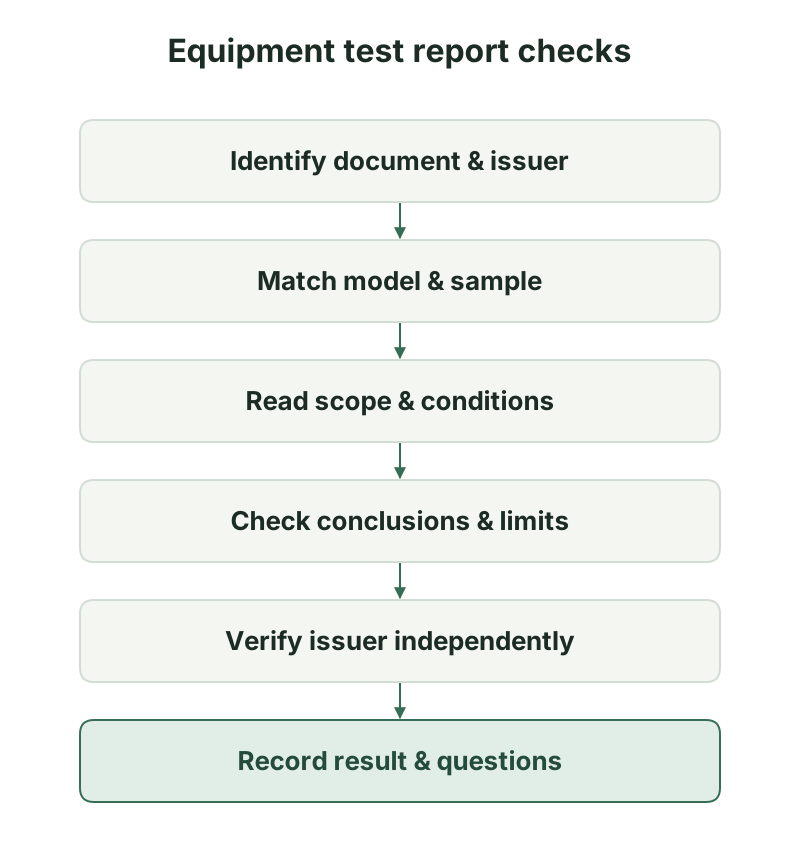
Match the report to the offered model
Many reports are accurate and still irrelevant, because they describe a neighboring product. Compare each of these against your quotation or datasheet:
- Model name and part number, including any suffix for color, region or battery type
- Variant or configuration: with or without case, strap, battery pack, accessories
- Hardware revision and firmware version, where software affects the result
- Sample description: how many units, and whether serial numbers are listed
- Report date against the production date of what you will receive
If the report says “series” or “family”, ask which members were tested and why the others are considered equivalent. If the sample was a pre-production unit, ask whether the design has changed. If the report gives no serial numbers, it cannot be tied to any unit, and you should record that gap rather than assume a match.
Read the test scope and conditions
The scope section tells you what was actually done. Record these items:
- Standard and edition, such as the document number and its year or revision letter. “Current revision” is not an edition.
- Method and procedure within the standard
- Levels, durations and cycle counts, with units
- Number of samples and whether one unit went through every test
- Pass criteria, and whether they were defined before the test
- Deviations from the method, with reasons
Standards are often tailored. For MIL-STD documents, the current revision can be checked through DLA ASSIST; compare it with the revision cited in the report, and do not rely on a revision named in marketing text. Where an ingress or immersion rating is claimed, check that the report states the actual test conditions, such as depth and duration, rather than only the code.
The conditions must also resemble your use. A test at one temperature or one drop height supports a claim at that level, not across your whole operating range. If your site conditions are broader, write the gap down.
A teaching simulation
The following is a teaching simulation. The laboratory, product and every value are fictional and exist only to show how to read a report. SavvySkull did not run any test, and this does not describe a real device or report.
| Field in the simulated report | What you would record | Follow-up question |
|---|---|---|
| Issuer: “Example Test Laboratories” | Name only; no accreditation shown | Is the method inside the lab’s accreditation scope? |
| Product: “Model X-100 handheld” | Model matches the quote; no firmware stated | Which firmware was tested? |
| Standard: “per MIL-STD-810, current revision” | No revision letter | Which revision was used? |
| Result: “Passed drop test” | No height, surface or drop count | What were the drop parameters? |
| Samples: “production units” | No serial numbers | How many, and which units? |
Reading this, you would mark the standard, result and sample entries as unclear and send questions before relying on the claim.
Check the stated conclusions and limitations
Read the results before the summary. Then compare the conclusion with them. A conclusion of “pass” is only as strong as the pass criteria and the measured values it rests on. Watch for these patterns:
- A summary that states a broader result than the data tables show
- Pass criteria that are not measurable, such as “functional after test” with no named functions
- Results reported for some tests but not others listed in the scope
- A conclusion that changes the standard’s limits or criteria without comment
Then read the limitations. Laboratory reports typically include a statement that results relate only to the items tested, and often that the report must not be reproduced except in full. Treat that as a boundary: the report supports claims about the tested sample in the tested configuration. It does not describe every unit produced later. If a supplier shows only selected pages, ask for the complete report, including appendices and photographs of the setup.
Verify the issuer independently
Contact details printed in a supplier’s PDF are not a verification channel. Find the laboratory’s own website through a search you control, take the contact details from there, and ask whether the report number exists, whether it was issued for the named product and whether the supplier-provided copy matches the original. Some issuers have an online lookup; others will answer a written request. Record whom you contacted and what they confirmed.
Then check accreditation. Accreditation is granted by an accreditation body for a defined scope, so the question is whether the lab’s scope covers the method in your report, not whether the lab is accredited in general. The ILAC MRA signatory list shows which accreditation bodies take part in that arrangement, and IAF covers the equivalent arrangement for certification bodies. An accreditation body such as A2LA publishes its accredited organizations and their scopes; other bodies do the same, so use the one named on the lab’s documents. An accreditation symbol on a report should be matched to a current entry, and the method in your report should appear in that entry’s scope.
For certification marks used on products for US workplaces, the OSHA NRTL program recognizes testing and certification organizations, and its current list of NRTLs shows who is recognized and for what scope. A mark from an organization that is not on that list does not mean the same thing, and a mark does not substitute for a test report on a specific performance claim.
Record verification and follow-up questions
Every check ends with a recorded result: OK, Mismatch or Unclear. Unclear is a valid answer, and each one should become a question to the supplier. The record below is available as a CSV. One copy per report keeps later procurement files consistent, and it pairs with a request for documents in your RFQ. Add the report to your equipment register when you buy, so maintenance planning can reference the same model and variant. The Checklists & Templates page lists the file.
Test report verification record
| Check | What to record | Result | Follow-up question |
|---|---|---|---|
| Document type | Report, certificate, listing, declaration or datasheet | OK / Mismatch / Unclear | Is a full test report available? |
| Issuer | Legal name, address, signatory | OK / Mismatch / Unclear | Who requested the test? |
| Accreditation and scope | Body, certificate number, method in scope | OK / Mismatch / Unclear | Does the scope cover this method? |
| Report number and contact | Number, date, contact from lab’s own site | OK / Mismatch / Unclear | Can the lab confirm this number? |
| Model and variant | Model, part number, configuration | OK / Mismatch / Unclear | Is this the variant offered? |
| Sample description | Count, serial numbers, firmware | OK / Mismatch / Unclear | Which units were tested? |
| Standard and edition | Document number, year or revision | OK / Mismatch / Unclear | Which edition was used? |
| Method and procedure | Method, procedure, levels, durations | OK / Mismatch / Unclear | Which levels were applied? |
| Conditions | Temperature, depth, height, cycles | OK / Mismatch / Unclear | How do these compare to our use? |
| Pass criteria | Defined criteria, before or after test | OK / Mismatch / Unclear | Who defined them? |
| Results vs conclusion | Measured values against the stated conclusion | OK / Mismatch / Unclear | Which data supports the conclusion? |
| Deviations | Any change from the method | OK / Mismatch / Unclear | Why was it changed? |
| Limitations | Scope statements and exclusions | OK / Mismatch / Unclear | What is not covered? |
| Date | Test date, report date | OK / Mismatch / Unclear | Has the design changed since? |
Questions to send to the supplier
- Please provide the complete original report, including appendices and setup photographs.
- Which model, hardware revision and firmware were tested, and are they the ones in this quotation?
- Which serial numbers were tested, and how many samples were used?
- Which standard edition, method and procedure were used, at what levels and durations?
- How were the pass criteria defined, and who defined them?
- Can you give the laboratory’s own contact route so we can confirm the report number?
Conditions and limits of this guide
This guide is based on published documentation of accreditation and recognition programs and describes a way to organize questions. It is not a test, and SavvySkull is not a laboratory or certification body. It does not replace accreditation review or conformity assessment, and it cannot say whether a given standard is the right one for a regulated or safety-critical use. If your requirement is regulatory, ask a qualified specialist or the relevant authority.
Downloads
- Test report verification record (CSV) CSV One row per check; fill in one copy per report.
Sources and versions
- ILAC MRA and signatories , International Laboratory Accreditation Cooperation Supports: Where to find which accreditation bodies are signatories to the ILAC Mutual Recognition Arrangement
- IAF , International Accreditation Forum Supports: International body for accreditation of certification and inspection bodies; starting point for its multilateral arrangement
- A2LA , American Association for Laboratory Accreditation Supports: Example of an accreditation body; accredited organizations and their scopes are published by the body
- Nationally Recognized Testing Laboratory Program , U.S. Occupational Safety and Health Administration Supports: Overview of the OSHA recognition program for organizations that test and certify products for US workplaces
- Current list of NRTLs , U.S. Occupational Safety and Health Administration Supports: Current list of recognized organizations; check each entry's recognized scope
- DLA ASSIST Quick Search , Defense Logistics Agency Supports: Where to look up the current revision of a MIL-STD document
Next steps
How to Write an RFQ for Outdoor Equipment
How to write a request for quotation for outdoor equipment: measurable requirements, documents, commercial terms and a response table that makes quotes comparable.
Outdoor Equipment Maintenance: Building a Practical Schedule
Build an outdoor equipment maintenance schedule from model manuals: equipment register, trigger types, task types, roles, records, and a downloadable template.