IP Ratings for Outdoor Equipment: How to Read Protection Claims
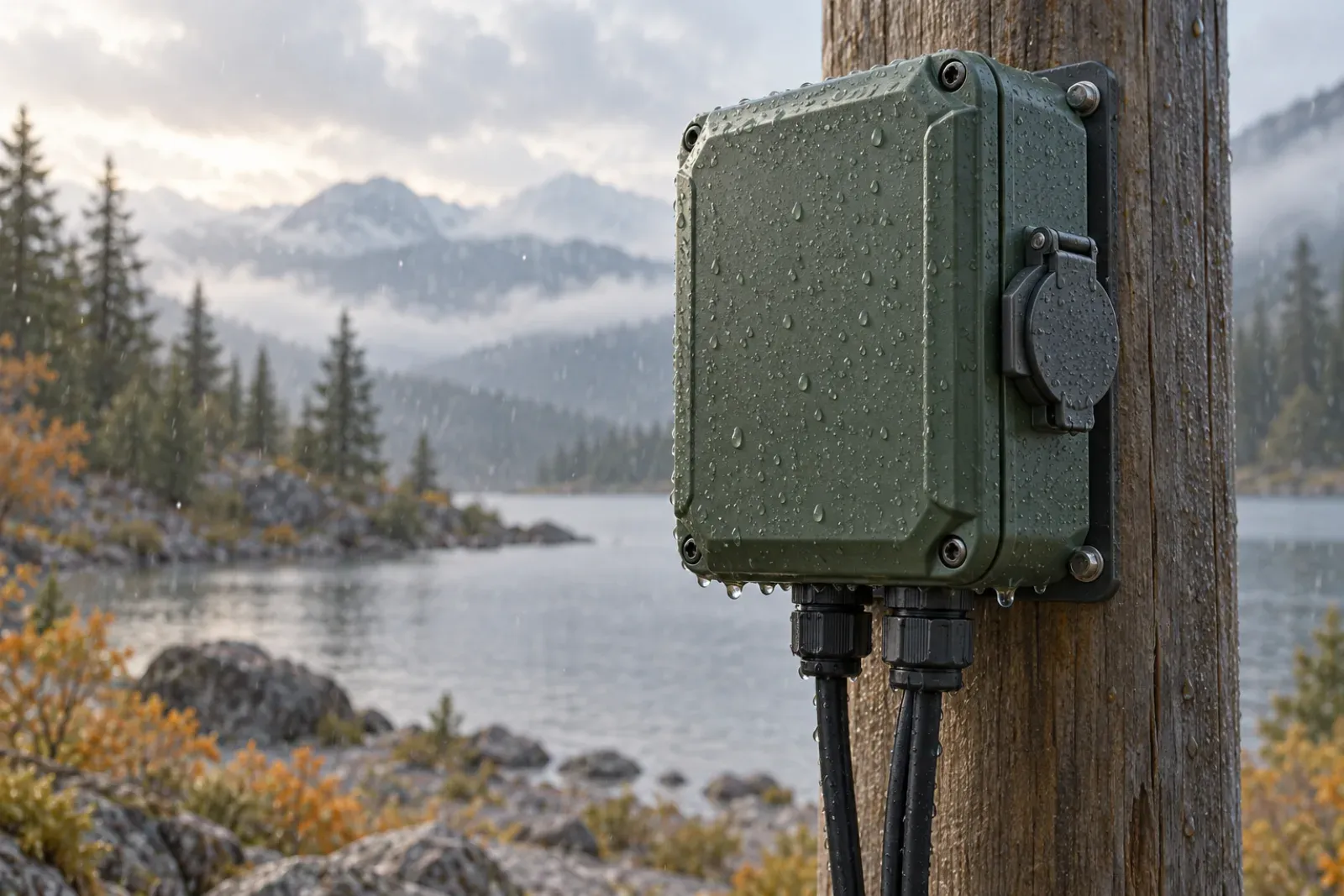
An IP rating is short, and that is the problem. Two digits on a data sheet get read as “waterproof” or “dustproof,” when the code only summarizes a defined laboratory test. This guide shows how to read the claim, what it covers, and what evidence is still missing before equipment goes outdoors. It is part of the Cases & Protection hub.
The system is defined in IEC 60529, and the IEC gives an overview on its IP ratings page. Test procedures and wording change between editions, so use the current edition of the standard for exact methods. This page explains how to read a claim; it does not reproduce the standard.
Find the exact protection claim
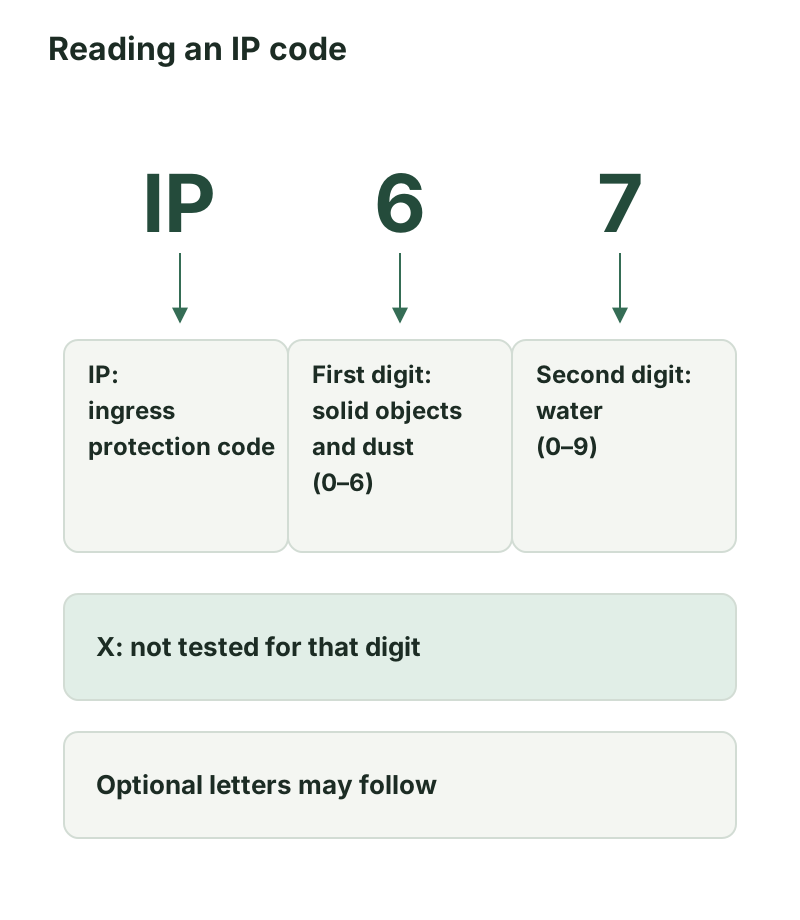
The code is the letters “IP,” a first digit for solid objects (0 to 6) and a second digit for water (0 to 9). A digit that was not tested or not specified is written “X,” as in IPX7 or IP6X. An optional additional letter and supplementary letters may follow.
| Digit | Meaning in short |
|---|---|
| First 1 to 4 | Protection against solid objects larger than 50 mm, 12.5 mm, 2.5 mm and 1 mm |
| First 5 | Dust-protected |
| First 6 | Dust-tight |
| Second 1 to 2 | Vertically dripping water; dripping with the enclosure tilted up to 15° |
| Second 3 to 4 | Spraying water up to 60°; splashing water |
| Second 5 to 6 | Water jets (6.3 mm nozzle); powerful jets (12.5 mm nozzle) |
| Second 7 | Temporary immersion (test up to 1 m for 30 minutes) |
| Second 8 | Continuous immersion under conditions the manufacturer specifies, more severe than 7 |
| Second 9 | High-pressure, high-temperature jets |
Three reading habits prevent most mistakes.
- Up to 6, a higher water digit covers the lower ones. Digits 7 and 8 do not. A product marked only IPX7 has not claimed resistance to jets. That is why some products carry dual marks such as IPX6/IPX7.
- IPX8 with no depth or duration is an incomplete claim. The conditions are set by the manufacturer, so they must be stated.
- An “X” is not a zero and not a pass. IPX7 says nothing about dust.
Be careful with two look-alikes. IP69K comes from a different standard family, so check which standard the supplier cites. NEMA enclosure types are a separate system. This page gives no equivalence table, and you should not assume that one exists.
Identify the cited standard and tested model
A claim is only as useful as its basis. For each rating, record:
- The standard and edition cited (for example, IEC 60529 and its edition year).
- The exact model name and variant that was tested.
- The testing organization and the report number or date.
- Whether the claim comes from a test report, a self-declaration by the manufacturer, or a catalog line with no source.
A rating printed in a brochure is a manufacturer claim until a document supports it. A supplier may declare conformity without third-party testing. That is not wrong in itself, but you should know which situation you are in. For how to read the report once you have it, see how to check a supplier’s test report.
Variants matter. A model sold in two colors, with two port layouts or with an optional accessory may not share a test result. Ask the supplier to say in writing that the report covers the variant you are buying.
Read the conditions and limits of the evidence
An IP rating describes performance in a laboratory test. It applies to the tested configuration, meaning covers, caps and ports closed as the maker specifies, on a new sample. It does not describe what happens after months outdoors.
The code does not cover:
- UV exposure and the aging of plastics and rubber
- Corrosion, including salt air and fertilizer or road-salt exposure
- Temperature cycling and the pressure changes it can cause
- Condensation inside the housing
- Seal aging, compression set and wear from repeated opening
- Impact, vibration or dropping
- Cleaning chemicals and detergents
None of this means the rating is unreliable. It means the rating answers one question, and your outdoor use raises others. If your site involves wash-down, dust of a particular type, immersion depth and duration, or chemicals, compare those conditions with the test conditions and ask for separate evidence where they differ. When you cannot find the information, treat it as unknown rather than assuming it is fine.
Where a maker gives an operating instruction that the rating depends on, such as “keep the port cover latched” or “replace the gasket if damaged,” that instruction is part of the claim. Capture it.
Separate component claims from whole-product claims
Field equipment is rarely one sealed box. A rating can attach to a part while the system around it has no rating at all.
- A sealed battery pack is not its charger. A rating on the pack does not make the charger, the charging connector or an open charging port rated. Check what the claim says about the system as it is used while charging.
- Port covers must be closed. A hinged cover, rubber plug or screw cap is part of the test configuration. If the equipment is used with the cover open, the rating does not apply to that state.
- Cable glands and mounting holes. An enclosure with a rating can lose it when someone adds a gland that is not matched to the cable, drills a mounting hole, or leaves a gland unused and unsealed. Ask whether the rating assumes factory-installed entries.
- A case rating is not a device rating. A rated case protects what is inside only while it is closed and in good condition. A device inside it has its own rating, or none. The reverse also holds: a rated device placed in an unrated bag is not protected by the bag.
- Lights, sensors and displays. A light housing may carry a rating while the switch, the lens seal or the power connector is the weak point. The portable work light buying guide shows where to look for a light’s environmental limits.
A useful test is to ask which parts the sentence “this product is IP__” includes. If the answer is “the main body, with the cover closed,” write that down.
IP claim check table
Use this table for each product you consider. The same columns are in the downloadable CSV, and the Checklists & Templates page lists it with the other templates.
| Claim as stated | Applies to (model, variant, configuration) | Test basis (standard, edition, lab, report no.) | Conditions and limits | Question before deployment |
|---|---|---|---|---|
| IPX7, as written on the data sheet | Model and variant name; accessories and covers in the tested state | Standard and edition; testing lab; report number and date | Depth and duration; covers closed; new sample | Does the report cover the exact variant and configuration we will use? |
| Dust-tight claim (IP6X) | Main housing only, or including connectors? | Same fields | Cover and port state; filter or vent openings | Which openings and entries were part of the test? |
| Dual mark (IPX6/IPX7) | Same variant and configuration for both digits | Both tests named in the report | Nozzle, flow and distance for jets; immersion conditions | Were both tests run on the same sample and configuration? |
Entries above are formatting examples only and do not state any real product’s rating.
Questions to ask before outdoor deployment
- What exactly is rated: the product, a component, or a case? Which model, variant and accessories?
- Which standard and edition does the claim cite, and which lab produced the report?
- Is the rating a test result or a self-declaration, and can we see the document?
- What configuration was tested (covers, ports, glands, mounting)?
- What does our site add: UV, salt, temperature swings, wash-down, chemicals, vibration?
- What does the manual say about inspecting and replacing seals? Plan for it in your maintenance schedule.
- Is the product going into a protective case? If so, the waterproof case procurement checklist covers what to check on the case itself.
- Who confirms in writing that the claim applies to the exact unit on the quote?
Put these answers in your request for quotation so suppliers reply in a comparable form.
Downloads
Sources and versions
- Ingress Protection (IP) ratings , IEC Supports: Structure of the IP code, the meaning of the digits and optional letters, and IEC 60529 as the basis of the system
Next steps
Choosing a Waterproof Equipment Case: A Procurement Checklist
A procurement checklist for waterproof equipment cases: dimensions, seals, latches, valves, rating claims, test report scope, spares and maintenance documents.
How to Check an Equipment Supplier’s Test Report
How to check a supplier's equipment test report: document type, issuer, model and sample match, scope, conclusions, accreditation, plus a downloadable record.